Sheila Stewart
August, 2003
[photo from Holly Jones memorial website]
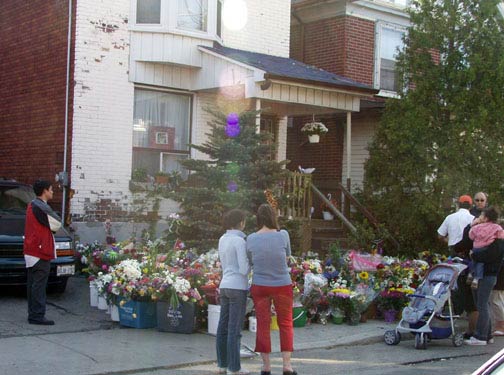
I kept the notices from my daughters' school issued in the aftermath of the death of Holly Jones, a 10-year-old girl who lived in our neighbourhood. I found them disturbing. The death of Holly Jones, who lived a few streets from our home, was a shock to our community. I have two daughters, age 9 and 12. I was disturbed by the media¹s sensationalising of the tragedy and its voyeuristic attention to the grieving family. How we respond and what we know of a tragic death is entwined with layers of media representation, and, in this case, with more local forms of representation, such as a mural in the local park. This tragedy was the main thing we talked about on my street, in the schoolyard, and in the coffee shops. I wonder how it affected learners at Parkdale Project Read, where I worked for many years as a community literacy worker, and whether the event had been discussed, read and written about there. It this brief write-up, I look at some of the contrasting literacy artifacts which surrounded Holly's death and raise some questions about local, institutional and media forms of literacy, as well as the tension between private and public literacies.
Jane Mace, in "Signatures and the lettered world" (Powerful Literacies, chapter 4), asks us to "considerŠthe different meanings that signatures and name-writing hold in the lettered world of the early twenty-first century"(p. 45). Holly had written her name in sidewalk cement some years before her death. Mace says "at a time when the technologies of writing allow us to transmit texts in all kinds of fonts and formats across great distances in a matter of seconds, it continues to be a literacy practice which has a deeply symbolic importance as a tool for empowerment." As I try to make some meaning of the way Holly's death got taken up locally and nationally, I am struck by the contrast between Holly¹s name written in her own hand on the street and her name as it became the household name of a girl known because of her murder.
Context:
Holly Jones went missing on May 13 and most of the remains of her body were found at a couple of places on the Lake Ontario shoreline early on May 14. Holly lived a few blocks northeast of us at the time of her death. She had lived for most of her life about five blocks south of us and during that time went to the local Catholic school, a school attended by some of the children on our street, but not my children. We didn¹t know Holly or her family, but we know a number of people who knew them well.
This event took place in the spring of 2003 in Toronto, where there was one difficult thing after another to assess how to talk about with my children. I had been thinking about the role of the school, as a major institution of social regulation, in shaping how we decide how to talk to our children about such events as 9/11, the outbreak of SARS (Sudden Acute Respiratory Syndrome), and the death of Holly. I'm also thinking about the media¹s effect on our feelings of powerlessness and anxiety. This event puts a new light on issues of safety, learning, powerlessness, and community meaning-making.
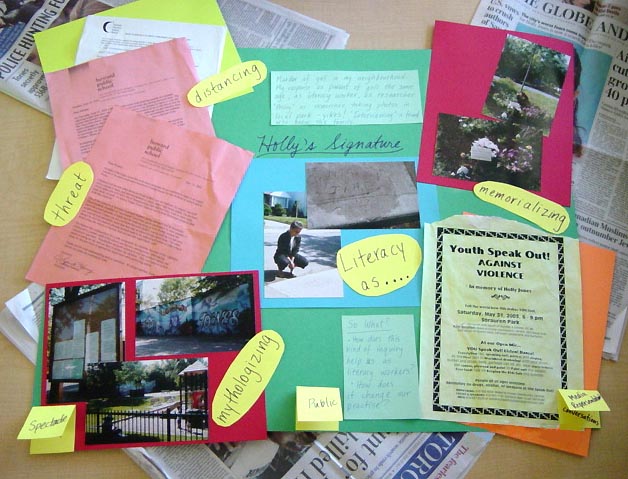
Research: My examination of how this tragedy got taken up locally and more widely included visiting two parks near my home. At Wabash Parkette, there is a large mural in memory of Holly. Beside it, at Sorauren Park, there is a smaller memorial with a plaque in front of a tree and surrounded by flowers. I visited these two parks, which I have been in many times, for the first time as a "researcher".
I interviewed my friend whose backyard had faced Holly¹s backyard for many years. She had known the family and her son had played with Holly a lot. We talked about the funeral, which my friend had attended, and her impressions of the service and what it had meant to those present. We also talked about a commemorative event she was planning with some neighbours, which would include planting a holly bush.
My friend had told me about Holly's name written by Holly in the sidewalk and we looked carefully at her signature as she had made it. Holly¹s name written on the sidewalk is part of a tradition of graffiti, like names carved in desks or spray-painted on walls. Mace points out how these names in public places can be viewed as romantic inscriptions or as defacements (p. 49). Mace quotes Mary Wolfe who says, "this writing is counter culture; in a prohibited public space, it is the personal made public."
School letters: I examined three letters sent home from my children¹s school after the event. The first letter about this event was sent home with every child on May 14. One line, ³Children will be safe when those involved in their care are vigilant,² struck me as untrue and as putting the blame on parents. Something about the blend of tones in the letter was disconcerting it seemed to be at once institutional and specific to our community. The letter was signed by the principal and the day care supervisor, but I wonder if the initiative for the letter came from a more centralized authority, such as the superintendent. Subsequent letters on the same colour of paper appeared in the next few weeks, one about a suspicious looking van which a child felt had been following him. Another, the next day, to report that this was a false alarm, the van was owned by someone in the community. Picking my children up at school I was aware of a feeling of panic when the children streamed out of the school with these notices. I also thought of the added difficulty such a situation might create for people with low literacy skills.
Mural: I heard first about the mural from a friend, another mother in the neighbourhood, who said it was "too much, too fast." The mural was painted on a wall, which ran along beside a basketball court. In the centre was a larger than life image of Holly's face. Wabash Parkette is a small park with playground equipment, mainly frequently by young children and their parents or care-givers. Later in the day it is frequented by older children playing basketball or hanging around. I have yet to find out who designed and who painted the mural, but my sense is that it was part of a general park improvement plan already underway for Wabash Parkette. Another new initiative in the park is a locked notice board, which has pages of information about soccer games' times, etc. The mural seems also to be part of the mythologizing and glorification of Holly and her story. Mary Hamilton raised an interesting question in our class about how such public artifacts are acting upon us when we aren¹t consciously "reading" them, when they become part of the backdrop.
Self as Researcher:
I felt conspicuous with my camera as I took pictures of the mural, memorial, and park activity. I felt awkward in the park with my camera, imagining that I looked like a ³reporter² and people are sick of reporters¹ attention to our neighbourhood and the tragedy. I felt aware of myself "composing" the photos to show parents and children in the park with the mural as a backdrop. When I usually walk through that park I look around to see who I might know, but in this investigation I failed to notice that one of my neighbours was there until she spoke to me. I want to return to this park without my camera and try to observe how people interact with this mural. I¹d like to ask people what they think of it.
Analysis: To some degree, I avoided the national newspapers, the Globe, the Star, and the National Post, of May 14, but I also wanted every bit of information available. I was both drawn to and repelled by the media coverage. Once my children learned to read, the newspapers had a different place in our home. This was particularly true after 9/11, which to some degree we tried to shelter our children from. 9/11 was another time when the school as an institution played a major part in shaping our children¹s awareness and interpretation of a tragic event. In the days following the death of Holly, like the days after 9/11, we tried to keep the newspapers out of sight, and not make them a visible part of home.
Local literacy expressions/manifestation are in sharp contrast to the media¹s sensationalizing and mythologizing of Holly, her death, and her family's reaction. A sign on a local church read: Sympathy to the family and friends of Holly Jones. The day the body was found people from the local boxing club had stood outside the club with signs that said, No to violence.
I'm interested in how literacy is tied up with important transitions in life, in this case with death. Literacy practices are used as markers and words become icons. The background to this study is current urban Canadian cultural practices around death and mourning, particularly those around the tragic death of a child. Holly's parents, Maria and George, wrote a poem to Holly which was read at the funeral and appeared in the newspaper. Strangers wrote notes to the family and Maria was quoted in the paper as saying that she had read every one of these cards and notes.
There is much more to examine about how literacy shapes and is shaped by particular cultural practices around death. We might also ask how this is different for different communities and people depending on their relationship to dominant forms of literacy.
Relevance to learning and teaching:
Reflecting on this incident brings to mind a comment made by a co-worker at Project Read a few years ago, "We help people learn how to read bad news." She had just helped a learner read his divorce papers. Another day it might be notices sent home from a teacher or principal, letters from social services, and then there's the newspaper. Much of what emerges from these texts is distressing, and as literacy workers we are also aware of the difficulty and marginality of the lives of Parkdale literacy learners, who are living in poverty and facing various forms of discrimination. This "bad news" is quite different from the cheerful way that literacy learning and teaching is often presented in national campaigns and perhaps also by ourselves when we do tutor training.
A critical approach to the media's hype and voyeurism and to their shaping of story is an important part of the work of literacy learners and practitioners. A more skills-based approach to literacy leaves little room for taking up events which impact on our lives and untangling the ways that literacies are enmeshed in our understanding of the world.
Literacy work is also about choices around self-expression and I think that is also part of what drew me to Holly's signature on the sidewalk. Holly's name was written a multitude of places at school and at home and, in time, these artifacts produced in those particular settings will reduce in number. Her own account of herself is largely gone and absorbed by a public portrayal of her and her family. Literacy learners in community-based settings write about their lives in ways which are less likely to occur in other more institutional settings.
Final Thoughts:
How does literacy interact with the other cultural and social practices which shape our understanding of death and mourning? How is this taken up by the media if a tragic death occurs in a neighbourhood described "inner-city" and "ethnic"? How might we discuss and work with such media stories in literacy teaching and learning? The contrast between private vs. public, and between local conversations and practices vs. media spectacle and representation are relevant to the literacy work we do. If we approach literacy as tied up with social change and understanding, we need to examine the interaction of these multiple literacies.
resources
Signatures and the lettered world by Jane Mace, in Powerful Literacies Jim Crowther, Mary Hamilton and Lyn Tett, eds. (2001). Leicester, UK: National Institute of Adult Continuing Education.
review of Powerful Literacies from the National Literacy Trust.
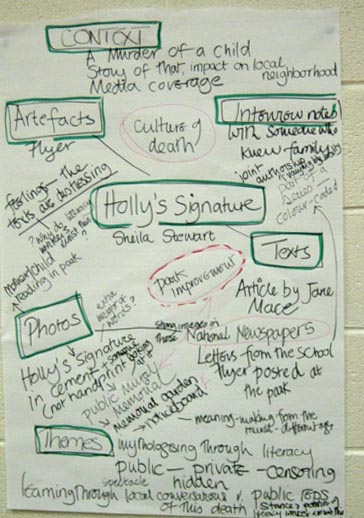
chart : literacy elements / Holly's signature
poster: Holly's signature
Sheila Stewart can be receached at sstewart@oise.utoronto.ca
back to Newfoundland course overview
page created 5 September, 2003
updated 8 September, 2003