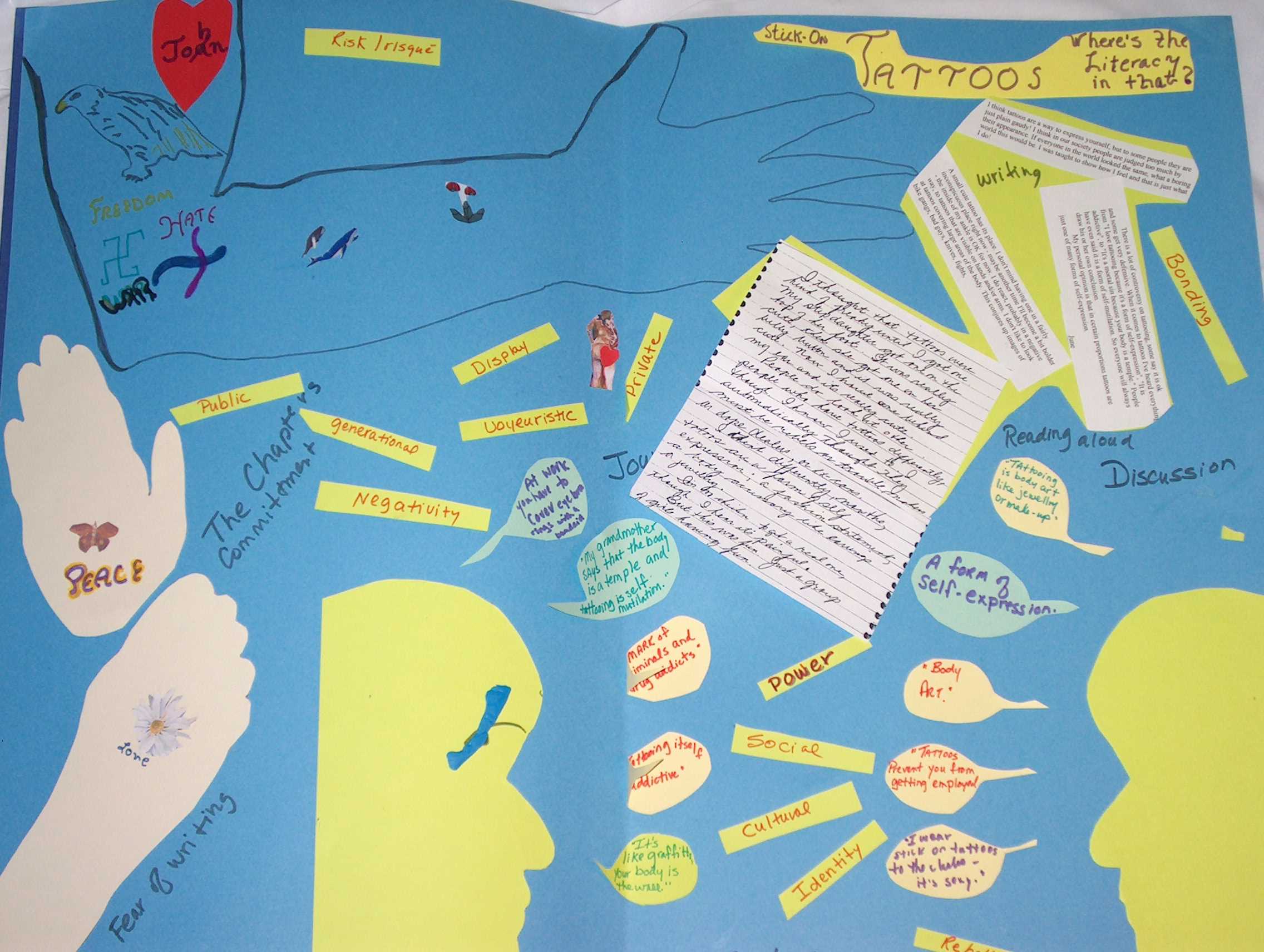
Stick on Tattoos - Where's the literacy in that?
Jan Greer Langley
Stick on Tattoos - Where's the literacy in that?
Jan Greer Langley
Context:
Tattooing is a form of body adornment accepted within certain subcultures. It can be controversial, however, depending on the individual's personal view and upbringing.
Stick-on tattoos were used as a writing prompt with five learners in a Community Academic Program, an intermediate level literacy program, in Fredericton, New Brunswick. This was an exercise suggested in Writing Out Loud, a resource/writing tool developed by Deborah Morgan that teaches practitioners interesting ways to support learners in their writing. My roles were: a facilitator engaged in delivering a practicum in order to become a certified Writing Out Loud Instructor; a participant and a researcher.
The classroom was made up of females: three students, each with varying degrees of writing abilities and their teacher. Their ages ranged from twenty-something to fifty-something. Although primarily the teacher and her students determine the classroom activities, there is an existing hierarchy, a three-way partnership consisting of the provincial department of education, community and business. Tattooing likely would not have been seen from the outside as a viable literacy or learning engagement.
Writing was not embedded in the lives of these women; they did not write for pleasure, in fact, rarely wrote at all except when their studies called for it. I gave them each a journal for the Writing Out Loud activities. The could keep the journals. Prior to the event, we went over the "Chapters commitment" as seen on the poster and "fears about writing." These lists were co-constructed with the learners.
The tattooing literacy event took place on the second morning of training. At this point an honest and trusting relationship had formed between us except for one woman who was returning to the class following a two-year absence and therefore a newcomer to the Writing Out Loud concept. Up to the point of introducing the tattooing, there had been about eight preceding literacy events.
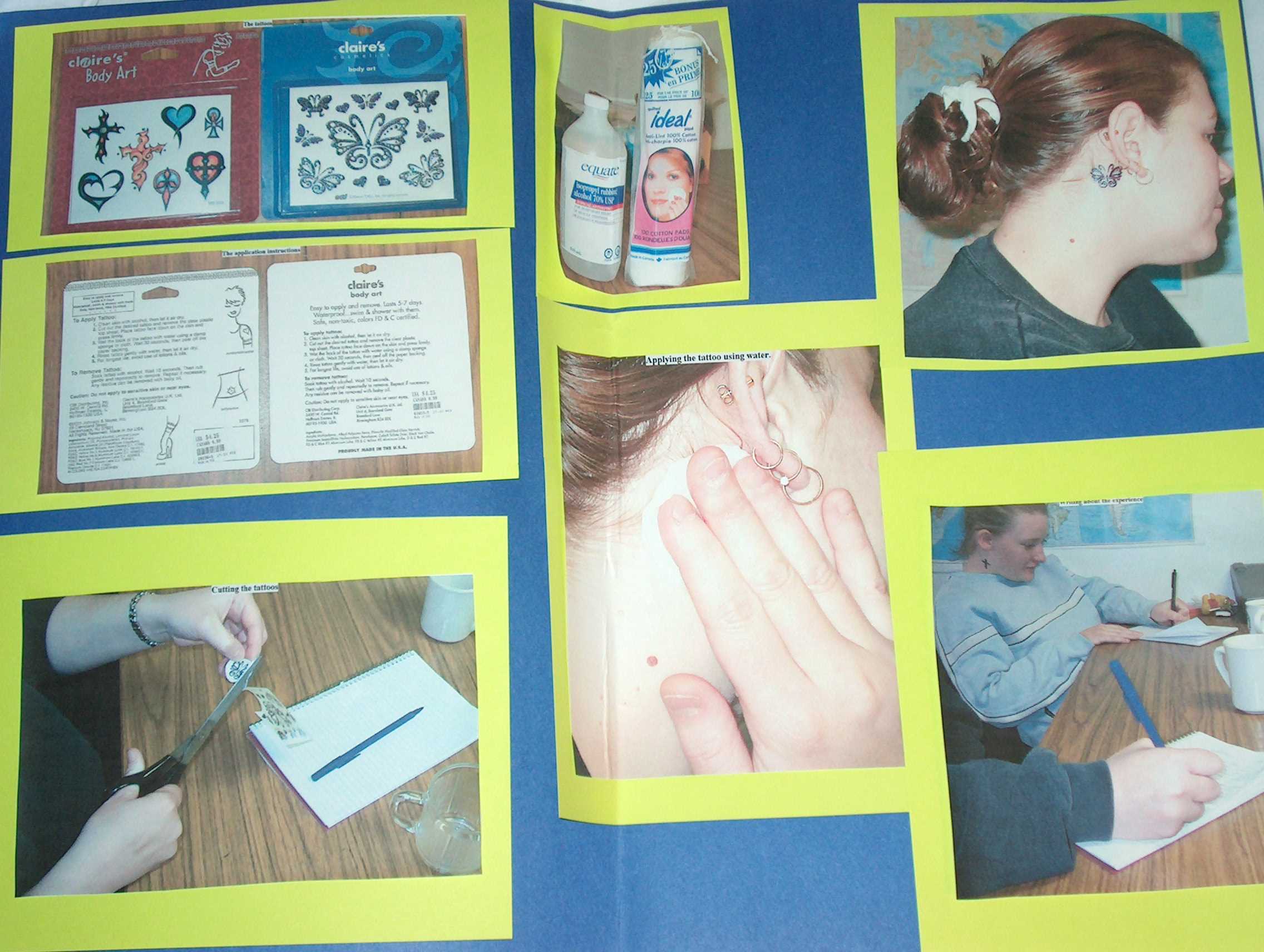
As you can see from the poster display [top of page] this literacy event included reading and following instructions, writing about the experiences and an in-depth dialogue that spread outward from the topic.
The literacy artifacts included:Description of the event:
When the stick-on tattoos were introduced, a range of emotional responses became evident; two of the younger women were excited, the two older women appeared apprehensive and the researcher brought an assumption that the event might be controversial, even met with disapproval.
The conflicts or tensions arising from the activity included:
Methods:
Observation, participation and dialogue.
Themes:
It was noted that the following themes emerged.
As a result of the event, views about tattoos changed and assumptions were challenged. The women each said that they would continue writing in their journals and that they had no idea how much fun writing and reading aloud could be.
One woman stated that she rarely wrote at all because she was afraid of making mistakes and that she would never read aloud but because of the supportive environment, she felt good about reading aloud even though she could not write as much as the others.
The women agreed that when they saw someone with tattoos from now on, they would see that person with more openness and in a more positive light than they did before the exercise.
Conclusion:
Tattooing - where's the literacy in that? The tattoos we used in the experiment were symbols not words. Symbols are a form of literacy and are among the first forms of literacy that we recognize. In this experiment, I think it is the process around the tattooing that provided rich literacy experiences, which push the boundaries of literacy solely as text. The process of tattooing provided the participants the opportunities to explore, choose, discuss, alter their views, write and then read aloud about their tattooing experience.
Jan Greer Langley can be contacted at jangreer@nb.aibn.com
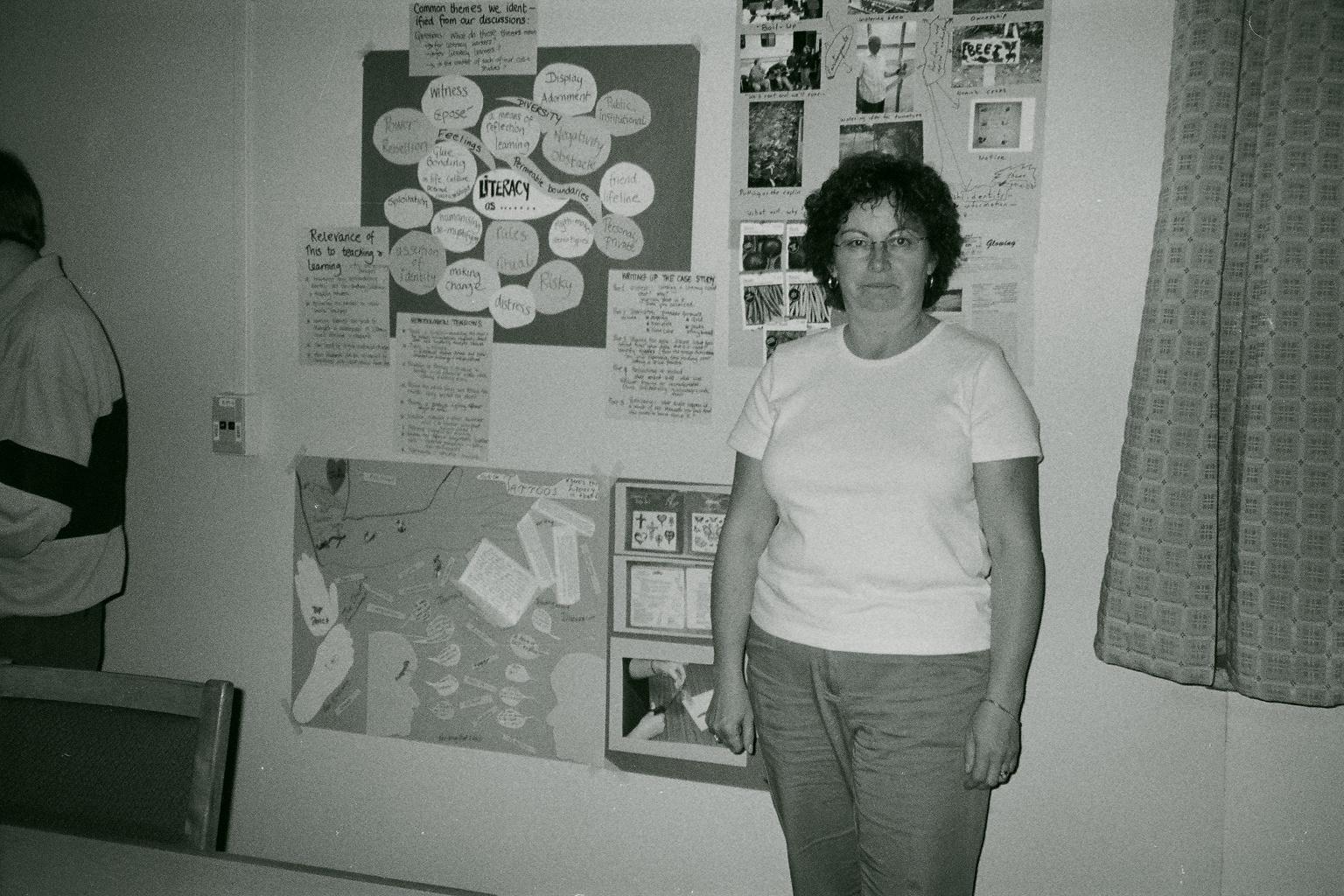
Jan and her poster
back to Newfoundland course overview
page created 21 July, 2003
updated 3 August, 2003