 signing the cheque
Janet Isserlis
signing the chequeThe context surrounding this project is that of the life, and death, of my great aunt Lil.
Funny, engaged, loving, and bright, Lil lived two months past her 96th birthday, and died in April of 2003. She'd been ill and in and out of hospital and nursing homes since the previous December. Several days before she died, she wrote a cheque for me, for my birthday. More accurately, early in the afternoon of my birthday, she had my mother write the date, my name, the figure and words: Lil then signed the cheque. I happened to be walking in to the hospital as my mother was leaving that day. She handed me the cheque on the street (as I was tying my hair back because Lil liked it that way. I'd tie it back going in and take it down going out of the lobby). I was struck by how dramatically Lil's signature had changed; the letters were scribbly; her usual characteristic writing had visibly changed. I no longer remember how much, if any, writing she'd done during her last month in hospital. I don't think she did much, beyond, maybe, circling items on a daily menu, when she was allowed to eat food that was food and not broth. I do know (or think I know) that during her last few weeks, she'd lost interest in reading Ð I think she found it exhausting Ð after having been an avid reader for as long as I'd known her.
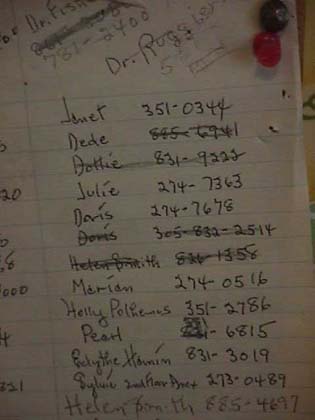
The signature and its impact led me to consider other evidence of literacies in her life, and to photograph artefacts in her home, thinking initially of a list of phone numbers that had been hanging on a bulletin board in her kitchen, by the phone, forever. Walking about the apartment (2 floors), I noticed both typical 'elderly' evidence (pill boxes sectioned off by compartments labeled with names of the days of the week, bottles of pills, not yet sorted into the box's weekly dose compartments, coupons for marketing) as well as the evidence of a woman who had traveled, loved her children and grandchildren, read abundantly and happily read her daughter-in-law's old copies of Vanity Fair and Architectural Digest.
I decided to photograph her home, a small townhouse-like flat (livingroom kitchen, hallway and toilet on the first floor, two small bedrooms and a full bathroom on the second). Thinking I'd come to photograph the bulletin board, I ended up doing a literacy scan. .I noticed her banking documents, neatly held together by a rubber band, laid out on a small table in her guest room. She had always balanced her chequebook to the penny, and had only, in March, relinquished control of it to her younger son.
I noticed a porcelain plate, emblazoned with a photo of her husband, Uncle Ben, (who had died suddenly in the early 70's), and with Chinese characters and the English words Taipei Taiwan
I noticed a book by Bharati Mukherjee I had given her in January; we'd realized that we'd both already read it, but she'd begun to reread it anyway, or had reread most of it until she gave up on reading, I think.
The walkabout of Lil's house challenged me as a researcher because I wasn't really finding anything 'new' to think about; my analysis was elusive Ð this is Lil, see how vital she was, how smart and how funny, how broadly interested in life; now she's gone, I miss her, see how her signature is emblematic of all that's changed.
Mary Hamilton reminds me, responding to a draft of this thinking-in-progress, of the importance of Lil's trusted family network, and suggests "that Lil seemed to be 'resting' within as she relinquished control of different aspects of her life." While Mary speculates the potential of such letting go for betrayal and loss, I think that for Lil it represented one more thing she didn't need to do as she came to be ready to, as she was wanting to die. She hated feeling that she was a burden to us (she wasn't); and, as Mary further suggests, this letting go doesn't have to be a bad thing, "depending on who's around." Quite simply, Lil was ready to go; whether or not we were ready to let her go is another question altogether.
Writing this, at a learner leadership conference in Florida, where workshops focus on breaking stereotypes about who adult learners are, puts me in mind of a first piece of thinking about the possible relevance of this study to anyone. For literacy practitioners it seems important to avoid stereotypes of older/elderly learners. Having worked for most of my 23 years in literacy with immigrants and refugees, of whom some, not all, have been elderly and with only one (elderly) native speaker of English (in a writing group in Vancouver), I realize that the particular abilities and interests of elderly people not in learning programmes might have something to tell me about those of elderly people working on language and literacy development with teachers and tutors.
To (over)generalize a bit: elderly people have made spaces in the world, have interacted with people and events that many of us, who are younger, may be familiar with Ð or not Ð but have not experienced in the way that someone who was alive before the advent of television, the internet, fruit leather or space exploration might. Older people know things that young people don't know and they know things differently.
While learning to read in a first or second language poses unique challenges to each learner, I wonder if practitioners overlook the importance of finding ways to understand the lives and interests of elderly learners, in aid of finding both materials to read, and stories to elicit, and in the uses and valuings of literacies in day to day lives. If the time we take to do things might be looked at differently; some older learners are quick and connected to the here and now. Some younger ones are, too. Conversely, others need time to integrate prior experience and ways of learning into literacy learning at an advanced age. Or need time to be heard, to articulate their understandings of how they've learned the many things they already know in the world and how these ways of learning might be used in service to using literacy and language for purposes they determine. Or as Mary succinctly suggests, we need to mindful of "the importance of validating other ways of knowing beside the conventionally literate, and the weave of oral and literate knowledges in peoples' lives."
Lil's artefacts and evidence also bring to mind the more finite issues surrounding the death of someone who has loved and been loved, who has left marks on the world. Institutional issues of control over one's own writing, one's possessions (where is the small tape recorder on which we were recording her recollections?) and well-being (when will a doctor be available?); receiving faxes whilst a patient in hospital (a special privilege) - - all these loose bits and pieces still want some sort of analysis, but are, at the moment, less interesting to me. Because of the work done by Hamilton, Barton et al within the parameters of the New Literacy Studies, Lil's bits and pieces do give me new evidence to consider when looking at how institutions control lives Ð through print, through regulation, through spoken and tacit rules.
I come from a line of women who only recently entered into formal higher education, (my mother) and who, nonetheless, love the word, use the word but also speak the word. I wonder why I only validate other people's stories, but would discount my own family's in this piece of the analysis. In other words, there are the relationships that literacies control (approve, marginalize, help, hinder) with institutions and authority. Then there is agency, and family, and love.
resources
Signatures and the lettered world by Jane Mace, in Powerful Literacies Jim Crowther, Mary Hamilton and Lyn Tett, eds. (2001). Leicester, UK: National Institute of Adult Continuing Education.
What's "new" in New Literacy Studies? Critical approaches to literacy in theory and practice, Brian Street, King's College London, in Current Issues in Comparative Education 5 (2) - article, May 12, 2003.
back to Newfoundland course overview
page created 8 July, 2003
updated 11 July, 2008