This was the information participants received prior to the start of the workshop:
Summary of what you need to do
Each workshop participant carries out a case study enquiry into a literacy event in one domain or setting ahead of time. If your main interest is "numeracy" rather than literacy, then just substitute the word "numeracy" throughout and "numbers" for "written text"
Each person will need to bring to the first session:
a maximum of 6 photos
2 "literacy artefacts" or texts
notes from an interview or discussion with participants in their chosen event
contextual notes from observations of the event.
What are "Literacy Events and practices"?
This workshop draws on a theory of literacy as social practiceput forward by Brian Street (1984); James Gee (1992) and David Barton and Mary Hamilton (1998). These writers see literacy as being part of social practices which are observable in literacy "events" or "moments" and are patterned by social institutions and power relationships. This approach encourages us to look beyond texts themselves to what people do with literacy, with whom, where, and how.
That is, we focus attention on the cultural practices within which the written word is embedded - the ways in which texts are socially regulated and used and the historical contexts from which these practices have developed. This leads us to consider the differentiated uses of literacy in varying cultural contexts. It leads us to consider not just print literacy but other mass media including visual and oral ways of communicating (see Kress and Van Leeuwen, 1996) and especially the way that the use of these media, using both old (print) and new (electronic) technologies, is interlinked. Writing becomes as central as reading, and other ways of interacting with print culture are identified.
The idea of a literacy event was first coined by Shirley Heath. She identified a literacy event as being any occasion in which a written text is involved in a social interaction (See Heath (1982, pp.93)
The idea of "literacy practices" is a broader, more abstract one which refers both to peoples' behaviour and their understandings of the uses of reading and/or writing. "Literacy practices" incorporate not only "literacy events" as observable occasions in which literacy plays a part, but also the ways we understand, feel and talk about those events.
This approach, then, focuses attention on the cultural practices within which the written word is embedded - the ways in which texts are socially regulated and used and the historical contexts from which these practices have developed. It leads us to consider the different uses of literacy in varying cultural contexts and how print literacy is used alongside other media, including new technologies.
This view of literacy demands that we make connections: with the community in which learners lead their lives outside the classroom; between learning and institutional power; between print literacy and other media; between our own literacies as teachers, learners, researchers and users of written texts and the theory presented here.
The focus shifts from literacy as deficit or lack, something people haven't got, to the many different ways that people engage with literacy, recognising difference and diversity and challenging how these differences are valued within our society. The NLS involves us in looking beyond educational settings to informal learning, and to the other official settings in which literacies play a key role. Learning does not just take place in classrooms and is not just concerned with methods.
These developments represent a significant change of perspective on literacy, a basic paradigm shift, in our understanding of reading and writing. The shift is from a psychological or cognitive model of a set of skills to one which includes the practices associated with reading and writing. It is a social view of literacy rather than a purely psychological one. It has to be historically and socially situated. As Brian Street puts it, it is a shift from literacy as an autonomous gift to be given to people, to an ideological understanding of literacy, placing it in its bigger context of institutional purposes and power relationships (see Street, 1995)
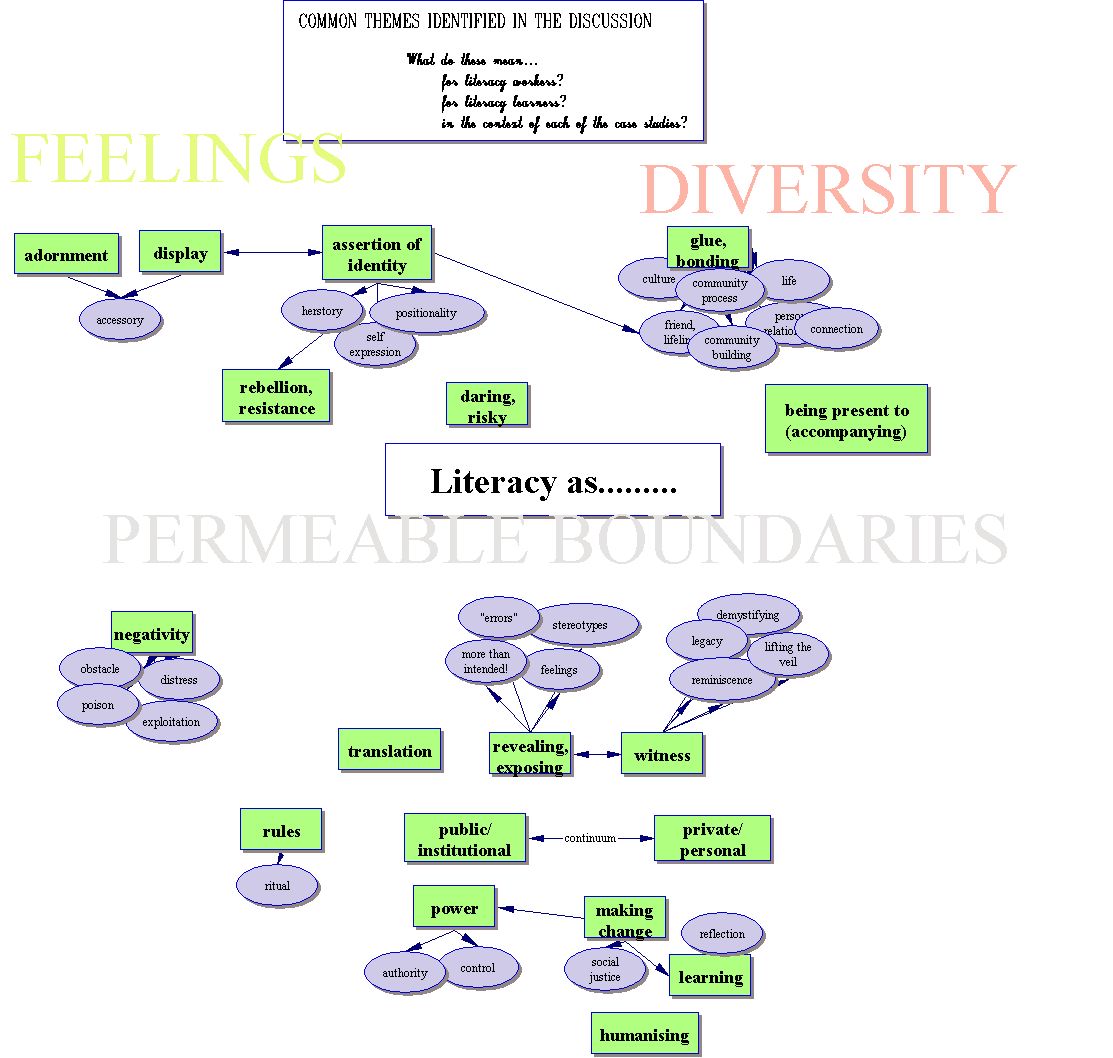
Main Elements of a Social Practice View
Every theory has its building blocks. The elements of a cognitive theory of literacy include such things as phonemes, words, sentences, comprehension skills, and metalinguistic awareness. The building blocks of a social practice theory include the following elements:
Participants who is involved in an interaction with a written text
Activities what they do with the text (and this is not just reading or writing, it can be displaying it, passing it on to others, or even erasing it).
Settings - where they do it physically in the kitchen, in bed, on the bus.
Domains - the institutional spaces that organize particular areas of social life and the literacy associated with it e.g. work, religion or health.
Resources these might be cognitive skills and knowledge; they might also be paper, a wall or other surface to write on, a computer, a printer, a set of coloured pens or a can of spray paint, a hammer and chisel.
It is important to notice that these elements include the physical technologies and circumstances within which literacy is accomplished, as well as cognitive, linguistic, visual and other symbolic resources.
Using the Literacy as Social Practice Framework:
What do these case studies tell us about literacy?.
What questions do they raise?.
e.g.
How are specific literacy events connected with bigger patterns?
How do literacies vary across different domains of social life?
How are different media intertwined (oral, print,c omputer-mediated, visual?)
How do social institutions determine the kinds of literacies people engage with?
Individual v collaborative authorship?
Change and literacy
Formal and informal learning
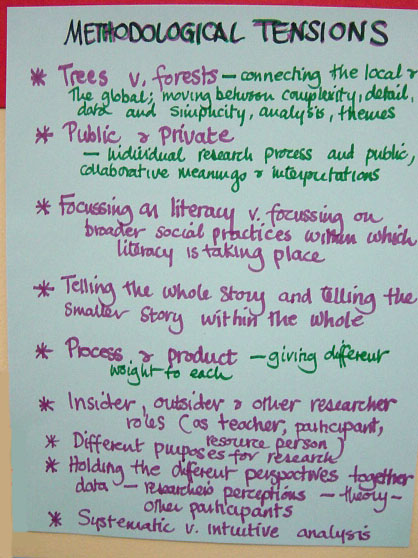
Methodological tensions:
If literacy is everywhere, it gets "watered down"
Research slips between social event and literacy event
Threads, moments, episodes (better than event?)
Simplifying and complicating ---- the trees and the forest
Read more about Literacy Events and Practices:
Barton, D . (2000) 'Researching Literacy Practices' in Situated Literacies (eds) Barton, D. Hamilton, M. and Ivanic, R. Routledge
Barton, D and Hamilton, M. (1998) Local Literacies: Reading and Writing in One Community Routledge (see ch 1 for more background on the idea of a social practice account of literacy).
How to Do the Case Study:
1. Step 1. Choose a domain or setting. Observe one literacy event. For something to qualify as a literacy event there must be a written text and at least one person involved. What counts as "being involved" is up to you to decide and this will be part of our discussion in the workshop. Since you will be recording this event in various ways and talking to those involved, make sure you choose an event that you feel confident about approaching. Best of all is to choose something that you are already knowledgeable about, have easy access to, but which might be slightly "specialist" to other people who are less familiar with it.
2. Step 2. Observe what is going on -- the interactions, the visual environment, the texts that are involved and that are visible around. Take written notes of what you have observed, and take at least two photographs. Try and get the people and a sense of the activities into your photos don¹t just focus on the texts themselves. For some examples of photographs see >a href ="http://www.ling.lancs.ac.uk/groups/literacy/photos/photos.htm"> http://www.ling.lancs.ac.uk/groups/literacy/photos/photos.htm.
3. Step 3. Talk to the people involved with the literacy activity and make notes, or a tape recording from your conversations with them. The point of your conversation is to get as full information as possible about the questions below.
4. Step 4. Decide on the "artefacts" you will collect to bring to the workshop either the originals or copies of them. One of these would ideally be one of the texts/documents involved in the literacy event, but could include the tools/materials used to produce the texts, or some other object that was involved in the event (a coffee cup? a plastic wallet, a piece of clothing? a celebratory decoration?)
5. Step 5. Use the questions listed below to answer the key questions about your chosen literacy event. You can do this quite briefly, but the more you find out under each heading, the richer your case study will be and the more productive it will make the group discussion during the conference
Questions to answer about your chosen literacy event!
What is the event you have chosen?
Who is involved with this literacy event?
Where is it taking place? (physical setting)
Why is it happening? (NB: There may be different views about this from different people involved!)
What led up to this event and what exactly is happening?(describe the activities as accurately as you can)
How is it being carried out? (details of the artefacts used, including texts, tools, timing)
How does this event feel to those taking part?
How do people know how to act in this situation and how did they learn to do it?
Are there any "skills gaps" in what you have observed?
What's the history behind this event how have things come to be organized in this way? And is this organization changing?
Who decides what people do in this setting and how are these decisions made?
Can you identify points of tension or conflict associated with this activity/setting?
Are there other people connected to this event who are not present? How are they connected to it?
Are there rules about who can take part in this event and what they can or can't do?
What will happen as a result of this literacy event taking place.?
Ideas for Choosing an Event or Domain for your Case Study
Any area of life is a possible focus for your case study including:
You might decide to choose an event from your own life or that of your immediate circle of colleagues, friends and family; or a learner you work with. Go further afield if you are sure you can get good access to the information you need to collect.
A list of projects carried out at Lancaster can be found on http://www.ling.lancs.ac.uk/groups/literacy/posters.html together with the commentary by David Barton that is attached to these guidelines.
Specific areas that people have looked at in the past include:
Writing up your case study of a Literacy Event
Section 1 Context
choosing an event: what? Why?
your own part in it<,r>
what date did you collect
Section 2 Description of the event
Possible formats:
Draw a visual map of it
Narrative
Photostory board
Timeline (chronological)
Use the grid to answer questions in turn
Section 3 Taming the Data
Your reflections/analysis of what you learned from documenting this case study:Section 4 Method
What worked well, what was difficult, what was interesting about the process of documenting this case study?
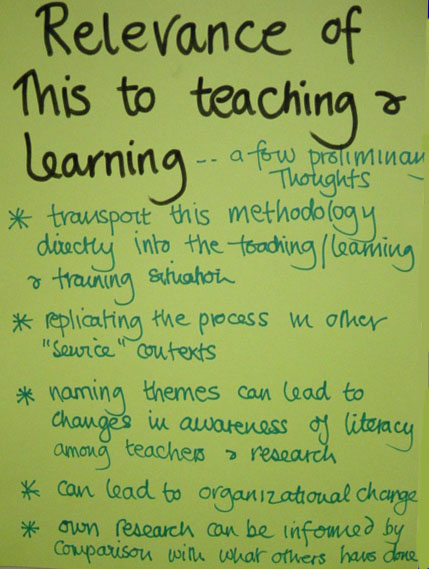
Section 5 Relevance
What might happen as a result of this case study?
Who wants to know about it?
read more about it: Students researching literacy practicesm by David Barton
(An online version of this text, complete with links to student projects, is available at http://www.ling.lancs.ac.uk/groups/literacy/posters.html)
About Mary Hamilton
I am Professor of Adult Learning and Literacy based in the Department of Educational Research at Lancaster University, England and a member of the Lancaster Literacy Research Centre. Lancaster is part of a new government funded National Research and Development Centre for Adult Literacy and Numeracy.
My involvement with adult literacy started in the late 1970s when I was a volunteer and then a part-time tutor in London. I was a founder member of the national network, Research and Practice in Adult Literacy (RaPAL). I have always seen professional development as central to the idea of making links between practice and research and I am course director of a new postgraduate Diploma in Adult Literacy, Numeracy and ESOL at Lancaster. I am also co-convenor of a research council-funded seminar series exploring links between research, policy and practice in the field of adult literacy, numeracy, and ESOL.
My main areas of research interest are in policy issues and public representations of literacy; comparative perspectives on adult literacy and numeracy, especially across industrialised societies; processes of informal adult learning and issues of access and transition for mature students. I am interested in different research methodologies, particularly qualitative and participatory models of research, also the potential of using visual data (such as photographs) to document everyday practices.
My current research is a 30-month Research Council (ESRC) funded project called Changing Faces: A Critical History of Adult Literacy, Numeracy and ESOL in the UK 1970-2000.
Recent books have included Local Literacies (with David Barton); Situated Literacies (edited with David Barton and Roz Ivanic) and Powerful Literacies (with Jim Crowther and Lynn Tett). If you would like to find out more about the research and writing I have done, there are details on my webpage at http://www.lancs.ac.uk/staff/eramh/.
additional resources
Becoming expert: using ethnographies of everyday learning to inform the education of adults, Mary Hamilton, Literacy Research Group, Department of Educational Research, Lancaster University, UK.
Adult Literacy in the United Kingdom: A History of Research and Practice: "Brian V. Street (1995-11) briefly locates literacy work in the United Kingdom in a broader historical perspective, from the Norman Conquest to the "Settlements" movement in the 19th century, and identifies recurrent themes as well as significant points of change. It then examines the history of the adult literacy movement in the United Kingdom in the post-war period, reporting on three phases in recent work. (NCAL Brief: TR95-05, 54 pages). [synopsis here]
back to Newfoundland course overview
page created 2 July, 2003
updated 11 September, 2003