I am very much involved with residents in a Government housing area in a small city. There is a Community Centre which offers about 25 programs in health, recreation, economic development, social events, and education/literacy. One of the projects of the Centre is a Community Garden with about 40 plots on about 2 1/2 acres of land in a nearby Provincial park. This project has four goals: 1. To provide opportunity for members of the community to grow vegetables for their use. 2. To allow space for non-community members to interact with and support community members. 3. To provide a spirit of community or togetherness among community members and between community and non-community members. 4. To provide opportunity for non-community members to support the community, such as contributing produce to the community food bank. While there are many instances when literacy is used, such as reading seed packets, I introduced a Community Garden Newsletter three years ago to communicate information about gardening to garden members and to help foster a sense of community among members.
Description of Event.
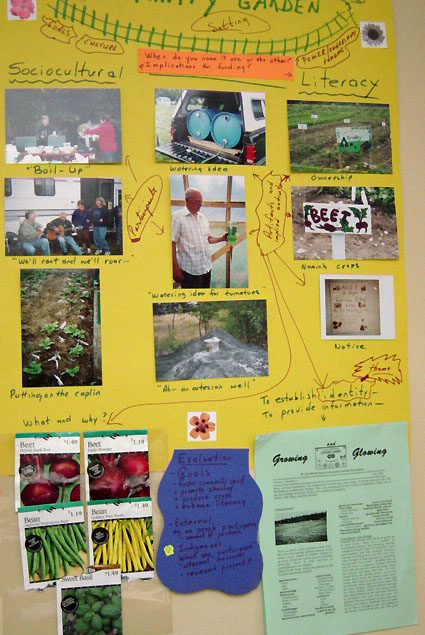
The Community Garden Newsletter is published once a month from June to September. It is about eight pages. The first issue provides a diagram of the garden and the names of participants. Garden tips, recipes, and other helpful information is provided. Most of the Newsletter contains photos of garden members in their various garden roles, signs on garden plots, notices of business or social gatherings in the garden during the garden season. The garden members look forward to the Newsletter and frequently ask when the next issue is due. They read the information but are also amused by the photos, even when they know beforehand that a certain photo will appear. The Newsletters are placed in a rack in the garden shed with a notice on the outside door that they are ready. Garden members sit at picnic tables or on the grassy laneway between plots and read and share comments on items and photos. There is a lot of bantering. For example, one participant may say, "Mary Ellen have you seen your picture?" to which she replies (knowing already which photo it is), "Oh my, he didn't put that in, did he? I'm afraid to look", yet is dying with curiousity to do so.
Reflection/Analysis
A study of the community garden event raised the issue of how social and literacy events interact. I now think of the relationship as occurring along a continuum so that a particular event may be mainly social or mainly literate. While a social event may be dichotomous from a literacy event, it is unlikely that a literacy event can be mutually exclusive from a social event since literacy events occur in social contexts. While the community garden is mainly a social/agricultural event, there are pockets of literacy as indicated, such as reading notices, seed packets, etc. But the garden Newsletter interjects an event that is mainly literate since the focus is on print and reaction to print. However, a large part of this medium is picture or non-verbal which evokes social interactions but which are now accompanied by language both written and oral. While one has no difficulty in seeing the relationship of print to literacy, the presence and function of pictures is more problematic. These seem to be mediators between literacy and social occurrences. While they enhance the print that accompanies them, their images evoke a social context to which participants readily relate in terms of memory and to which they can now "ground" the accompanying print. This suggests a role for pictures in literacy events which I had not thought of before.
From a theoretical stance, the literacy occurring during the community garden newsletter event may be considered "display", in the sense that tips and other useful information are displayed, and "enabling" or "identity" since the newsletter was initiated to foster an awareness of community and to engender common goals among all.
A third point that arose from this activity is the notion of evaluation. As I reflected on how the community garden members evaluated the success of the garden I realized the difference between evaluation imposed on them and their own internal measures, which I term "indigenous". The number of gardeners participating, the occupation of all plots, the weighing and counting produce at harvest are measures imposed by the Community Centre and carried out by the garden coordinator. However, in talking to garden members you find that the attendance at social events during the garden season, which include a barbecue and a boil-up (cooked mean of meat and fresh vegetables, contributed by plot holders) is an indication if the garden project is going well. They also cite the support of other gardeners whether giving tips, such as how to scare birds from eating sprouting beans, to commiserating about losing crops to diseases, such as club root infesting turnips, or blight attacking potatoes.
Where From Here?
I had not really analysed the garden newsletter as a literacy event and how it differed from the garden event as social/agricultural. Nor had I thought of the role of pictures in printed matter, especially for people whose reading skills may not be that high. I feel that producing newsletters will now entail a metacognitive role for me. I will be questioning each item in terms of its role, vis-à -vis the garden goals, and whether the newsletter item really enhances meeting those goals. I will be much more alert to evaluation and in the final issue of the newsletter will provide opportunity for garden participants to evaluate the success of the garden project for the season. How I will do this is not clear - informal conversation, print questionnaire, oral survey, observation, etc. It is always nice not to have all the answers for the future; otherwise there would be no suspense, no challenge, no growth.
As I write this I think about the interpretation of literacy events for research purposes. I find this more difficult to write at this point than if I had done so while involved in the Institute on Research and Practice/Adult Literacy. I believe the points of interpreting events may be considered as "stages removed" from the immediacy of the event. If I were standing in the garden and were asked questions about the newsletter as a literacy event I think my responses would be different from my discussions of this event in a seminar, and different again from my remembering now. I think interpreting events at the time of their occurrence leads to more subjectivity and richness of detail in terms of social interaction. The more removed one is from an event at the time of interpretation the more likely it involves generalization influenced by other research and related literature. I do not think it is a matter of one being better than the other but of different kinds of interpretation occurring depending on when the interpretation is made.
additional resources
Literacy for Living, by William Fagan.
Fagan, William T. (1998). Literacy for living: A study of literacy and
cultural context in rural Canadian communities. Institute of Social and Economic Research, Memorial University, St. John's, NL.
A Theory of Everything by Ken Wilbur
Wilber, Ken. (2000). A theory of everything: An integral vision for
business, politics, science and spirituality. Boston: Shambhala.
William T. Fagan can be contacted at wfagan@mun.ca
back to Newfoundland course overview
page created 8 July, 2003
updated 7 September, 2003