At the Balmoral Centre for Adult Studies student generated events are encouraged. Students attending the Literacy and Basic Skills Programme (LBS) come from diverse multicultural and linguistic backgrounds. The LBS students come from First Nations communities, Mexico, and Portugal and English is their second language. The rest of the class is composed of local students whose first language is English. The instructors at the centre encourage social interaction and cultural sharing among all students as part of a school community building process. The research to be presented will explore a cultural sharing literacy event entitled "A Mexican Morning."
Cheryl, an instructor with the Balmoral Centre for Adult Studies, encourages students to present something of interest to them which they would like to share with other members of the class on Friday mornings. In this instance, Elisa, a Mexican woman, was teaching the class about making Quesadillas. As the researcher, I observed and photographed the event, interviewed the participants, and collected two artifacts: a salsa recipe which was written in English, and an Instant Corn Masa Mix bag on which was written the tortilla recipe and ingredients in three languages (Spanish, French and English).
Description of the Event
The literacy event, A Mexican Morning, is described in the following grid.
| What is the event you have chosen? | Mexican Morning |
| Who is involved with this literacy event? | Literacy and Basic Skills Learners at the Balmoral Centre for Adult Studies |
| Where is it taking place? (Physical setting) | A classroom at the Balmoral Centre for Adult Studies |
| Why is it happening? (NB: There may be different views about this from different people involved!) | A student from Mexico is sharing her culture
with the LBS class. She is teaching her
classmates how to make Quesadillas.
Explain the recipe, share the salsa recipe; make the quesidillas. The process:
Teacher
|
| What led up to this event and what exactly is happening?(describe the activities as accurately as you can) | Other students have been sharing recipes,
baking, art work, and Stories. Elisa
volunteered to teach quesedilla making.
Elisa to prepare:
|
| How is it being carried out? (details of the artifacts used, including texts, tools, timing) | This event included recipes and reading directions for making Instant Corn Masa Mix. |
| How does this event feel to those taking part? |
|
| How do people know how to act in this situation and how did they learn to do it? | Elisa started to make the dough. She explained and demonstrated how to make tortillas. The students observing got curious then began to help. Students helped make and eat the quesadillas. |
| Are there any "skills gaps" you have observed? | The students had no idea how easy it was to make tortillas and were fascinated by the tortilla press. |
| What's the history behind this event - how have things come to be organized in this way? And is this organization changing? | These events are common practice in the communications class. |
| Who decides what people do in this setting and how are these decisions made? | Elisa was in charge and directed the event.
|
| Can you identify points of tension or conflict associated with this activity/setting? | Teacher got upset when dough fell on the
carpet
|
| Are there other people connected to this event who are not present? How are they connected to it? | Deloris from the day care lent a tortilla press to Elisa. Elisa repaid the kindness with quesadillas. |
| Are there rules about who can take part in this event and what they can or can't do? | No rules except that they must be a student at the Balmoral Centre. |
| What will happen as a result of this literacy event taking place.? | People are more excited about Mexican
cooking. Students were excited about trying it
at home. Students are exposed to new
vocabulary (tortilla, quesadilla, salsa, queso).
Talking about different cultures and food. Enjoying spicy food. |
Reflections and Analysis
As the group of literacy event researchers examined each singular event through the scrutiny of the artifacts, evidence, and photographs, my understanding of my own event shifted from finding limited themes and meaning to a paradigm of thematic connection to the other researchers' events. This asymmetry in thematic development was a function of ongoing conversation, poster creation and mapping that occurred between researchers and facilitators during the group process.
The theme that first emerged after my presentation was "co-constructed events." This emergent theme defined the event but appeared to be only weakly associated to the other events. On deep analysis through the group process other more connected themes began to materialize. From the emergent theme of "co-constructed events" developed connecting themes of literacy such as empowerment, literacy as ritual, literacy as assertion of identity, and literacy as display. Within each of these literacies was reflected the literacy of social practice. The theme of literacy as empowerment resonates throughout this literacy event: a woman sharing her culture of making Quesidillas; a sharing of her own volition giving her classmates a snapshot of understanding into her culture. She was proud to be sharing and teaching her peers and the sharing process elevated her self-esteem. Literacy as ritual and as display occur here as well in a particular way. By displaying a written recipe to me after her presentation, a recipe that she did not address in her teaching, yet used in her cooking, Elisa was displaying to me what she thought a teacher would like to see. The theme of literacy as ritual is also intertwined here, for Elisa it is the ritual of cooking and sharing as a display of culture. These lead to literacy as an assertion of identity describing both whom and what she is.
Method
A literacy event is like archeology where artifacts, evidence, and photographs are used to construct meaning. Limited meaning making occurs when one lone event is analysed. Many events examined together, like combined digs, created rich thematic meaning. The process of analysis was also very interesting. The dynamics of the analysis, moving from presenting each singular event, through constructing thematic connections to all events, to creating posters and connecting these visual constructs to the group of thematic connections revealed even more meaning. A literacy event is thus an interesting cognitive and meta-cognitive process in which the researcher first thinks about themes and meaning, and then thinks about how themes and meaning are constructed.
Relevance of Literacy Events to Teaching and Learning
The implication of transporting this methodology directly into student learning has relevance from a practitioner view point. Having literacy students use the literacy event model, as a method of examining the literacy of social practice, or other literacies of personal interest has positive pedagogical implications. The collection, presentation, analysis, discussion, mapping, decoding, connecting and reconnecting of meaning and themes embedded in the events presented would be very educational. Students would be able to connect their event to the events of other students and explore common themes within these literacies. Through this process deeper connections and understandings could evolve.
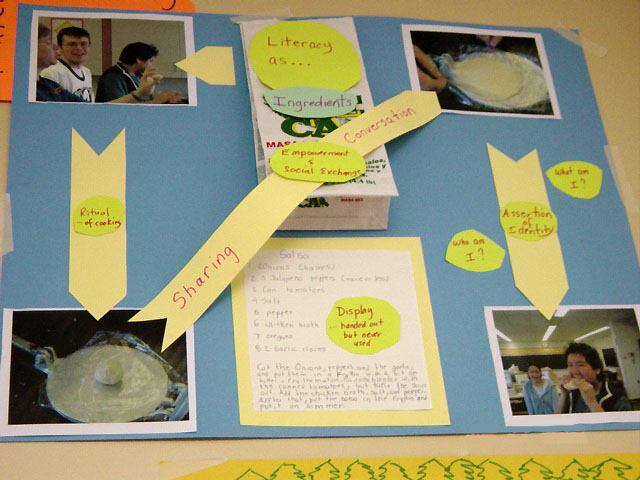
Poster: a Mexican Morning
back to Newfoundland course overview
page created 29 August, 2003; updated 7 September, 2003